Carbon Fiber Reinforcement: Transcending Atmospheric Limits
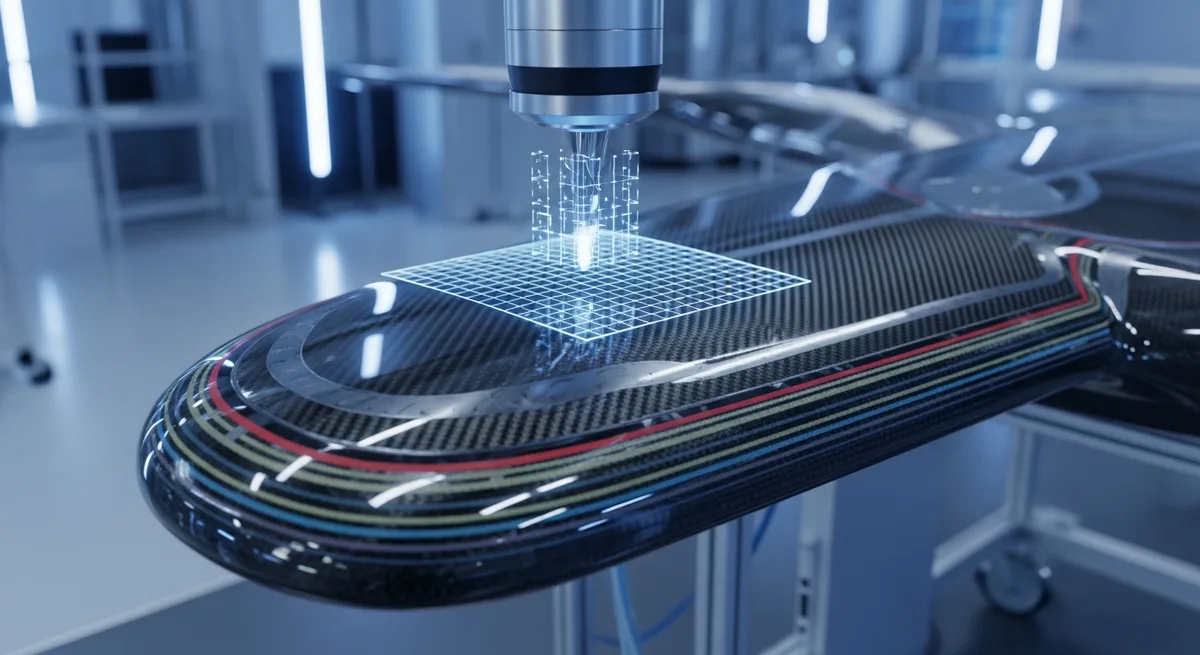
In the upper reaches of the atmosphere, where pressure plummets toward critical thresholds, engineering design transcends mere construction to become a high-stakes negotiation with the limits of physics. Here, carbon fiber synthesis—boasting a tensile strength of 4.5 GPa—serves as the primary structural anchor, while a Young’s modulus of 240 GPa renders the assembly indifferent to the chaotic resonance of ambient vibrations. With a density of a mere 1.8 g/cm³, this material effectively nullifies the accumulation of inertial forces that would otherwise plague traditional aluminum alloys, allowing the airframe to maintain its geometric integrity even amidst the violent shearing of aerodynamic vortices.
This fibrous skeleton demands a binding medium capable of withstanding the visceral weight of high-shear environments; an epoxy resin with a tensile strength of 80 MPa acts as the essential buffer against delamination. Possessing a Young’s modulus of 3.5 GPa, the resin functions as a mechanical energy distributor, preventing localized stresses from breaching the endurance limits of the material’s fabric. As the resin envelops the fibers, it saturates the interstitial voids, establishing the adhesion zones that dictate the structural coherence of the whole—a vital necessity, for without this matrix, the fiber bundles would succumb to the crushing inevitability of compressive failure.
During fabrication, the application of 0.1 MPa of vacuum pressure serves to purge microscopic air pockets—insidious defects that, if left unchecked, act as the seeds of future material degradation. A two-hour thermal cycle at 120°C initiates the polymerization of the resin, a process of profound chemical reorganization. Should the temperature gradient falter or distribute unevenly, internal stresses are locked into the matrix, destined to manifest as micro-fractures under operational loads, slowly compromising the integrity of the entire molecular framework.
A ten-millimeter-thick laminate, capable of enduring a compressive load of 450 MPa, stands as a testament to the twenty-layer CF/EP structure acting as a singular, unified block. At a 60% fiber volume fraction, the material reaches its engineering zenith, where bending forces up to 800 MPa fail to breach the structural frame. Once this threshold is surpassed, the internal matrix begins to undergo micro-deformations—invisible to the naked eye, yet signaling that the material has reached the terminal edge of its plasticity.
The wing, subjected to 100 kNm of bending and 50 kNm of torsional torque, maintains its profile despite surface stresses reaching 200 MPa. The precise orientation of the carbon fibers allows for the redirection of these forces along the axes of maximum strength, ensuring the structure remains immune to elastic fluttering. This behavioral model, predicated on the meticulous alignment of layers, guarantees that kinetic energy is channeled into the primary mounting nodes without the dissipative loss that would otherwise signal structural fatigue.
The structural anatomy relies on filaments seven micrometers in diameter, which, when bundled into hundred-micrometer strands, form a complex, woven architecture. Silane coupling agents act as chemical anchors at the interface, yet should this bond be compromised by moisture or chemical reagents, delamination is inevitable. This failure is catastrophic; once the resin detaches from the fiber, the load is no longer distributed with mathematical uniformity, and the material sheds its intended resistance.
An eight-layer quasi-isotropic laminate, oriented at 0°, 45°, 90°, and -45° angles, is engineered to absorb the chaotic flux of air currents. Each 1.25 mm sheet functions as a dynamic filter, while the finite element method allows for the precise calculation of how stress flows through this woven system. Digital modeling reveals that even the most infinitesimal deviation from the design orientation creates an instantaneous point of load concentration, a precursor to systemic structural failure.
Computational simulations allow us to observe the material’s response to drag, translating abstract calculations into a visceral physical reality. As the degree of wing deformation under high pressure is observed in the digital void, it becomes clear that the material’s behavior is fundamentally non-linear. It is a complex interplay of logic and physics, where every iterative calculation refines our understanding of how the material yields to an unpredictable environment.
The evolution from the boron fibers of the last century to the carbon nanotubes of the modern era marks a transition toward an ever-greater strength-to-weight ratio. The implementation of the VARTM process has largely eradicated the inaccuracies of manual labor, allowing materials to achieve superior fatigue resistance. Modern composites are no longer static substances; they are designed to endure the cyclical load fluctuations inherent in the fluid dynamics of flight.
3D printing now enables the cultivation of structures with variable density, optimized precisely where loads are most severe. This method allows us to abandon the monolithic construction of blocks in favor of organic growth principles, where the material fabric is densified at the points of maximum bending moments. Yet, such optimization demands absolute control, as any unevenness in the polymerization process can introduce internal voids.
Even the most perfect composite must contend with the relentless assault of radiation and extreme temperature fluctuations, which slowly erode the molecular framework. As an airframe endures tens of thousands of cycles, micro-cracking becomes an inescapable phenomenon, and the demands of the manufacturing process grow increasingly draconian. A single resin bubble, mere microns in size, can become the focal point where the slow decay of the material begins.
Certification processes mandated by agencies like NASA or the FAA are essential to detect internal delamination. Ultrasonic inspection probes for the slightest anomalies, which might otherwise bloom into structural collapse. This is not mere bureaucracy; it is a necessity to ensure that every component adheres to the physical requirements that guard against the entropy that constantly seeks to dismantle our technological order.
Future aircraft, leveraging these technologies, will be capable of reducing fuel consumption by up to 20%, transforming every gram into a metric of efficiency. A reduction in structural weight allows for an increase in payload, a critical factor in the success of space missions. Every technical detail is evaluated through the lens of the weight-to-power ratio, the optimization of which has become the primary engineering objective of our age.
The fundamental challenge remains the integration of complex composite components with metallic assemblies. This boundary between the rigid carbon fiber and the ductile metal creates a clash of disparate thermal expansion coefficients. Consequently, the joints are subjected to internal stresses that, over time, fracture even the most resilient adhesives or rivets, rendering these interfaces the primary source of systemic vulnerability.
We remain unable to fully reconcile materials whose expansion coefficients differ by an order of magnitude. This discordance within heterogeneous structures remains the greatest engineering barrier, forcing a continued reliance on mechanical fasteners. Until a method is devised to bind these distinct physical natures without the need for mechanical junctions, aviation systems will remain tethered to this technical paradox, where the connecting hardware will always be the most fragile element of the design.