Thermal Flux and Crystalline Dislocations: The Microscopic Dance of AIOS
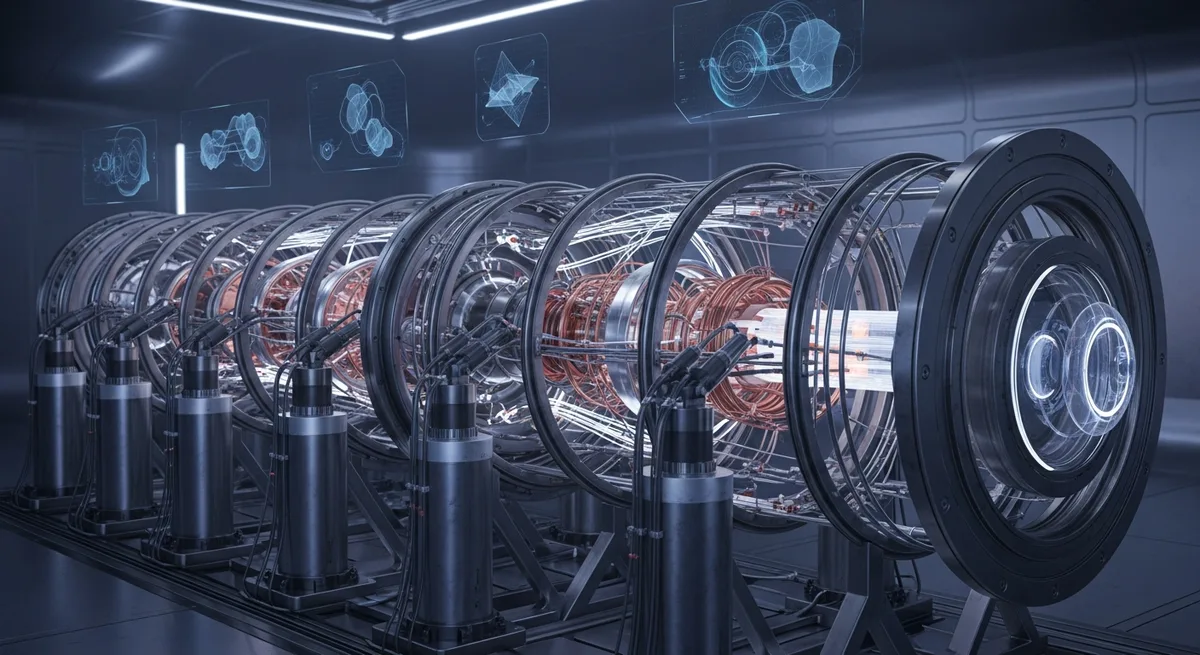
Within the architecture of the AIOS, the 304L stainless steel functions not as a passive housing, but as a pressurized force field, subjected to a relentless 75,000 psi. In this metallic skeleton, the coefficient of thermal expansion—anchored at 16.5 x 10^-6 K^-1—induces a state of perpetual internal friction, as thermal fluctuations force the crystalline structure to reorganize at a microscopic level. The construction endures a strain analogous to the grinding of tectonic plates, where every atomic displacement generates invisible yet mechanically palpable ripples, pushing stable compounds to the very edge of their elastic limit.
The tungsten filament, a mere 10 micrometers in diameter, serves as the theater where a 5 keV energy flux becomes an existential challenge to the material itself. Here, electron emission triggers thermionic discharge in a vacuum, causing the tungsten surface to sublimate and form a tenuous cloud of metallic vapor capable of contaminating the optical path. At this juncture, one observes not merely ionization, but a deleterious process of material erosion; as the 0.1 mrad divergence begins to fluctuate due to the geometric decay of the filament, the flux loses its intended trajectory, destabilizing the entire downstream ion-motion vector.
Magnets composed of a neodymium-iron-boron alloy generate a 1.4 tesla field, where a coercivity of 876 kA/m collides with the stubborn reality of magnetic hysteresis. As a 10 T/m gradient focuses particles into a 10-micrometer point, residual energy accumulates within the magnetic material, acting as a drag coefficient that scales proportionally with flux intensity. This phenomenon manifests as an unwanted field distortion, where magnetic domains lose the ability to return to their equilibrium state, rendering the focusing effect a slave to the system’s operational history rather than its programmed parameters.
Copper elements, boasting a conductivity of 59.6 x 10^7 Siemens/m, generate an intense heat flux reaching 386 W/m-K. While a surface roughness of 0.1 micrometers theoretically ensures laminar electron flow, the reality is one of surface ion implantation. The copper lattice—the only instance where this term truly applies—is gradually saturated with argon atoms, altering the material’s electrical resistance and triggering local micro-spikes in voltage that destabilize 10-nanometer resolution processes.
The vacuum environment, maintaining a pressure of 1 x 10^-8 mbar, is far from an absolute void. Residual gas molecules, colliding with the ion stream, trigger secondary ionization that generates stochastic bursts of photons. This phenomenon, known as residual gas glow, manifests as a background noise floor that masks target signals. Cryogenic pumps, while effective at removing the bulk of contaminants, introduce mechanical vibrations, transmitting 50–100 Hz oscillations throughout the structure that preclude the achievement of absolute flux stability.
Copper deflectors, modulating the stream at 100-microsecond intervals, contend with inductive lag. When 10 mrad angular shifts demand instantaneous voltage swings, capacitive charging occurs on the electrode surface, retarding response times. This moment of inertia implies that the system’s reaction to control commands is never immediate; it follows a characteristic delay curve that the FPGA processor must compensate for, yet due to the cyclical nature of the computation, a deviation of several nanoseconds remains an inescapable constant.
The channel electron multiplier registers ions with 50 percent efficiency, yet the remaining half ricochets off the detector walls, triggering back-emission. This secondary electron stream bleeds back into the system, spawning "ghost" signals that are erroneously interpreted as genuine ion events. A 100-nanosecond time resolution becomes a limiting factor, as the detector’s "dead time" following each trigger prevents the registration of particles arriving in rapid succession.
The FPGA control system, governing 10 kV of potential and 100 mA of current, is in a perpetual war with electromagnetic interference radiating from the power supplies themselves. Lorentz force analysis, performed to 0.1 percent accuracy, founders on the imperfections of the mathematical model: in a real-world system, non-homogeneous fields defy complete description by classical physics. The digital algorithm attempts to smooth these discrepancies, but every compensatory pulse only serves to increase the system’s thermal load, fueling a vicious cycle.
This 150-kilogram, 1.2-meter-long technological construct demonstrates that the mastery of matter is an unceasing struggle against entropy. Every component, from the tensile strength of the steel to the conductivity of the copper, introduces a physical perturbation that cannot be eliminated. As all forces reach a precarious balance, a fundamental engineering barrier emerges: quantum noise, arising from the inherent uncertainty in the trajectories of the electrons themselves, becomes the ultimate obstacle. The more precisely one attempts to focus the ion stream, the more aggressively the Heisenberg uncertainty principle asserts itself, dismantling the integrity of the ion optics and rendering zero-error an unreachable mathematical horizon.