The Enigma of the Oaken Core
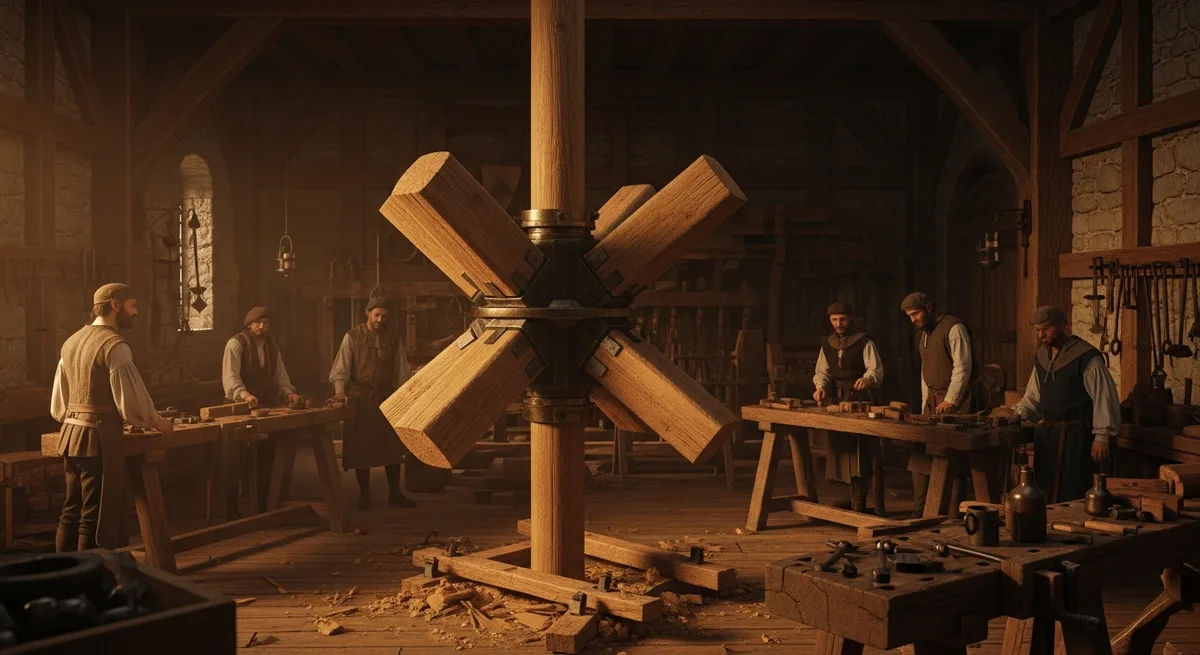
In the spring of 1485, within workshops heavy with the scent of resin and damp timber, master craftsmen labored to domesticate the invisible currents of the air. Their primary instrument—a 3.5-meter axle, turned from a single, monolithic oak log—was engineered to withstand a crushing magnitude of stress, as if tasked with anchoring the very pull of gravity. As the artisans strained against the levers, the wood emitted a low, guttural groan: the visceral resonance of internal fibers resisting tension, a sound akin to a thick hawser nearing its breaking point. Every millimeter of the axle was subjected to forces that modern metrics would quantify in tens of thousands of atmospheres, yet to the craftsmen of the era, it was merely the "sighing of the wood" under an insufferable burden.
At the heart of the axle, a cast-iron hub served as a dense anchor, its mass intended to provide the necessary inertia to the rotating assembly. This metallic node, forged in furnaces where fire reached temperatures of terrifying intensity, was designed to absorb the entirety of the torque generated by the men’s exertion. The metallurgists understood, however, that the internal matrix of the cast iron, though hard as bedrock, possessed a finite endurance: excessive strain would instantly propagate microscopic fissures, spider-webbing through the metal and signaling the imminent, catastrophic disintegration of the system.
Four oak blades, fixed to the axle at a twenty-degree pitch, were sculpted to cleave the air like honed steel. The masters meticulously carved each edge, striving for a perfect equilibrium of weight, for even the slightest deviation would induce a violent, structural shudder throughout the frame. As the assembly gained velocity, the wood flexed rhythmically, battling an air resistance that pressed against the surfaces like invisible, heavy palms. The fibers, stretched to their absolute limit, emitted a high-pitched creaking—a testament to how perilously close this primitive yet ambitious mechanical structure hovered to the brink of failure.
The interface between the blades and the hub relied upon bronze bearings, which proved a true trial of the masters' patience. These rings, with a diameter of 0.1 meters, were forced to endure immense radial loads while grinding incessantly against the cast-iron surface. As the mechanism accelerated, the bronze heated to such a degree that the air around the bearings began to shimmer, and the metal emitted a sharp, agonizing shriek. The craftsmen understood that this friction was not merely a sound, but a parasitic loss of energy that prevented the construction from reaching its target rotational velocity.
A mixture of olive oil and beeswax, applied to the bearing surfaces, served as the only fluid medium capable of filling the microscopic irregularities between the bronze and iron. This viscous lubricant, its consistency preventing premature leakage, formed a protective film intended to shield the metal from the ravages of welding friction. Under full load, the mixture released a distinct, acrid, scorched odor, signaling to the masters that the thermal threshold was approaching—the critical point where the lubricant would lose its integrity and the surfaces would begin to abrade into ruin.
Wooden dowels, driven deep into the structural sockets, were employed to secure the blades to the axle. These small but vital components were tasked with resisting the shear forces that sought to tear the timber from its moorings. Each dowel was subjected to the equivalent of a giant’s pliers attempting to snap the fastening point; consequently, the masters constantly inspected the adhesive layers, which were required to hold this immense tension and prevent the blades from detaching from the axle.
The entire 150-kilogram system demanded a precarious balance, as the center of gravity, offset from the axle, dictated unforgiving physical laws. As the mechanism accelerated, the force of inertia became increasingly unmanageable, causing the entire structure to vibrate like a living creature struggling to break free from its cage. The masters felt the axle shudder in their palms, transmitting every impact of air resistance, which rippled through the frame as a low, thunderous rumble.
The principle of the propeller’s operation was rooted in a balance of forces that the masters attempted to achieve by heaving against the levers. It required monumental physical effort to overcome the mechanical resistance and induce the air to flow. The vortices generated behind the blades appeared, to the eye, as invisible stairs upon which the machine was meant to ascend. Yet, each vortex also acted as a brake, creating a pressure gradient that pushed the blades backward, forcing the men to labor with even greater intensity.
Every component was calibrated to ensure that thermal expansion would not compromise the integrity of the whole. As the angle of the blades bit into the air, a powerful pitching moment was generated, which the bearings had to neutralize through their internal structural rigidity. It was a perpetual struggle between the stiffness of solid bodies and the fluidity of air molecules, where the slightest error resulted in mechanical collapse—the wood splintering or the bronze melting from a sudden, violent heat spike.
Biomimetics, though not yet defined by such a term, was evident in the masters' design choices. Observing the flexibility of avian wings, they attempted to replicate this property in the wooden construction, allowing it to deform slightly to maintain lift. Unlike nature, however, this mechanism lacked any system of self-regulation; there was only blind physics, which the masters had to manage manually, reacting in real-time to the slightest shifts in vibration.
The interface between the cast-iron hub and the wooden axle became the critical point of failure where metal met timber. A precise fit was essential to ensure that torque was not concentrated at a single point, but distributed across the entire contact surface. If the distribution of force was uneven, the axle would simply split longitudinally, as the wooden grain could not withstand the sudden mechanical shock that occurred when the system reached its limit of power.
The wear of the bronze bearings was dictated by their coefficient of friction, which, at high rotational speeds, generated enough heat to degrade the consistency of the oil-and-wax lubricant. This process was cyclical: the faster the axle turned, the hotter the bearings became, altering the viscosity of the lubricant and further increasing friction. This created an engineering feedback loop that prevented the system from exceeding a specific power threshold, regardless of the masters' efforts.
The propeller’s design relied on rigid geometry, yet the system remained unstable due to the inherent volatility of air currents. The air, which the masters perceived as a stable medium, was in reality a shifting, turbulent entity that the twenty-degree blades received as chaotic, jarring impacts. These shocks were transmitted through the axle directly into the masters' hands, forcing them to constantly adjust their input to prevent the mechanism from shaking itself apart.
Ultimately, the project of 1485 collided with the insurmountable limit of material strength. The ratio between the weight of the cast-iron hub and wooden blades and the power generated precluded sufficient lifting efficiency. The masters realized that to achieve flight, they would require either lighter materials capable of withstanding higher stresses or a more powerful energy source, as the torque provided by human muscle was a physical ceiling that could be sustained for only a fleeting moment before the system succumbed to material fatigue.
The primary engineering impasse remained unresolved: how to reconcile high kinetic energy with a fragile structure, when every additional unit of velocity exponentially increased the thermal load on the bearings and the mechanical stress on the axle joints. The system reached equilibrium only at the threshold where the friction between the bronze and iron neutralized the entirety of the torque, converting it into pure heat and leaving the mechanism spinning in place, devoid of any real displacement through space.